
Technical Reference for Water Well, Mining and Geotechnical Drilling
Originally published: 2026-06-15 | Last updated: 2026-08-16
Quick Answer
In most applications, PDC drill bit selection is governed by formation hardness and abrasiveness. Three-wing configurations typically deliver higher ROP in soft, non-abrasive formations. Four-wing concave designs generally provide better stability in medium-hard limestone and sandstone. For quartz-rich or abrasive formations, reinforced four-wing bits with wear-resistant cutter grades and enhanced gauge protection are often recommended. The primary economic criterion is usually cost per meter—not purchase price.
✍️ Technical Authorship
This guide was prepared by the Chenghui engineering team, drawing on field experience from drilling projects across Africa, the Middle East, South America, and Southeast Asia. The team includes mechanical engineers and geologists with practical experience in PDC bit design and application.
🔍 Technical Validation
Field performance data is anonymized but derived from actual project records.
1. Quick Answer: Matching PDC Bit Design to Formation
In many drilling projects, the borehole diameter remains constant, yet the geological conditions can vary with depth. This variation is often the cause of inefficient drilling and higher costs.
Continuing with the same PDC drill bit across multiple formations—or changing bits too frequently—both lead to poor results. The first approach reduces ROP and increases cutter wear. The second raises tripping time and labor costs.
Analysis of buying patterns shows that many PDC drill bit purchases are made based on diameter and price alone. However, field data indicates that this approach often leads to poor performance.
In drilling projects across Africa, Southeast Asia, and South America, the most cost-effective operations are those where PDC drill bit selection is based on a careful review of formation hardness, abrasive content, and target depth. This guide brings together field observations and engineering principles to help purchasing managers and drilling engineers make better decisions.
Experienced drilling contractors typically evaluate PDC drill bits using a different economic measure:
The most cost-effective drill bit is the one that delivers the lowest cost per drilled meter—not the lowest purchase price.
2. What Is a PDC Drill Bit?
A Polycrystalline Diamond Compact (PDC) drill bit is a fixed-cutter drilling tool that removes rock through a continuous shearing action. In practice, this mechanism works effectively in formations ranging from soft clay to medium-hard limestone and dolomite.
Each PDC cutter consists of a synthetic diamond layer bonded to a tungsten carbide substrate. This combination offers a balance of hardness and toughness. The quality of this bond is a key factor in cutter life.
Unlike roller cone bits, PDC drill bits have no moving mechanical parts. This design reduces maintenance needs and can help maintain consistent ROP in suitable formations.
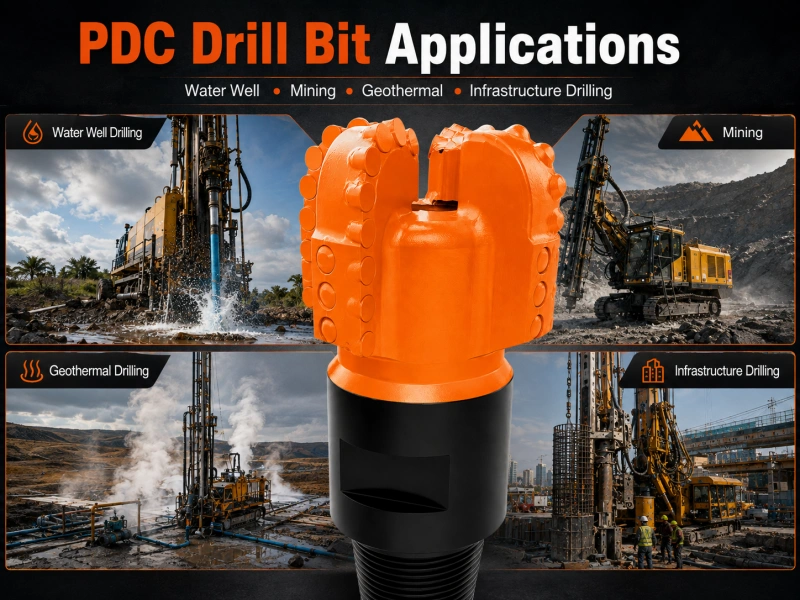
Applications where PDC drill bits are commonly used include:
- Water well drilling (municipal and agricultural)
- Geothermal boreholes
- Mineral exploration
- Coal mine gas drainage
- Geotechnical and foundation drilling
- Slope stabilization and anchor drilling
- Geological investigation
Manufacturing quality—including CNC machining precision, heat treatment, and cutter brazing—has a greater effect on service life than the number of cutters or blade count alone.
3. What Rock Properties Affect PDC Drill Bit Selection?
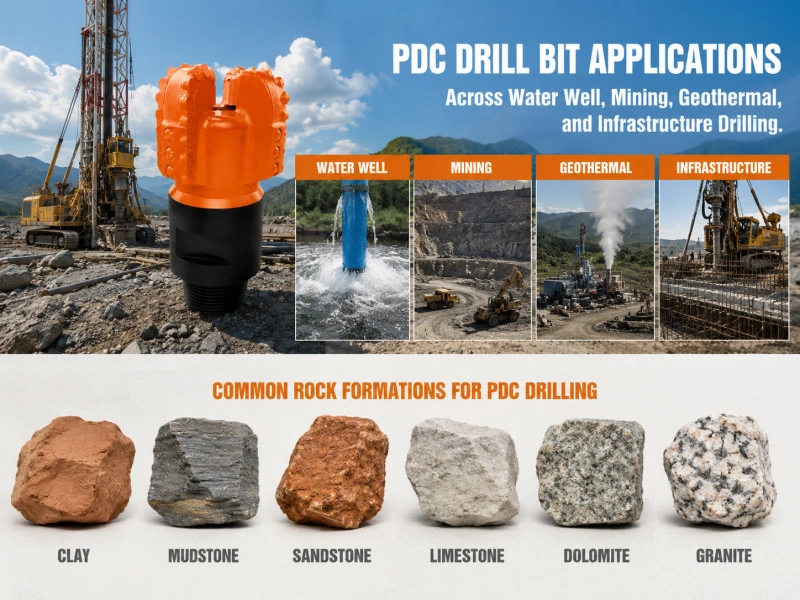
First, geological evaluation is conducted before tool selection in professional drilling operations. Even formations with similar compressive strength can show different drilling behavior due to differences in abrasive content, fracture density, and mineral composition.
Sandstone formations with higher quartz content can cause PDC cutter wear rates that are notably faster than those with lower quartz content. Similarly, limestone with chert nodules may produce impact damage not seen in homogeneous limestone.
3.1 Hardness / Compressive Strength
Formation hardness is a primary factor in PDC drill bit selection. As compressive strength rises, the cutting structure typically needs stronger cutter support and better diamond layers.
3.2 Abrasiveness and Quartz Content
Abrasiveness affects cutter wear rates. Formations with high quartz content can cause faster wear. Cutter grade selection and gauge protection become more important in these conditions.
3.3 Fractures and Interbedded Layers
Fractured and interbedded formations can create impact loading on PDC cutters. A common failure pattern is chipping or breakage of cutters when moving between hard and soft layers.
3.4 Clay Stickiness and Bit Balling
Clay presents a unique challenge: cuttings removal. When clay absorbs water, it becomes sticky and tends to build up around the bit face—a problem known as bit balling. In such cases, increasing WOB is rarely effective; improving hydraulic cleaning usually works better.
4. PDC Drill Bit Selection by Rock Formation
The following recommendations are based on field observations and are intended as general guidance. Specific conditions may need design adjustments.
4.1 Clay and Soft Soil Formations
In clay formations, the main challenge is not rock-breaking but cuttings removal. A 3-wing concave PDC bit with large junk slots is typically recommended. The open design improves cleaning and lowers the risk of bit balling.
4.2 Mudstone
Mudstone is common as an intermediate formation in many drilling projects. A 3-wing concave PDC design with 1308 cutters is often used in this formation.
4.3 Coal Seam
Coal is soft, but the surrounding roof and floor often contain sandstone or shale. A 3-wing PDC works well in soft coal, while 4-wing reinforced designs are often preferred when sandstone layers are present.
4.4 Sandstone
Sandstone is the most variable formation. Grain size, cementation, and quartz content directly affect PDC cutter wear. In quartz-rich sandstone, wear-resistant cutter grades and reinforced gauge protection are often recommended.
4.5 Limestone
Limestone is widely found in municipal water well drilling. A 4-wing concave PDC bit typically provides good stability and hole straightness in this formation.
4.6 Dolomite
Dolomite can cause higher cutter wear than many limestone formations, especially where abrasive content and mineral composition increase cutter loading. Reinforced 4-wing PDC bits with application-specific cutter grades are generally specified for this formation.
4.7 Weathered and Fractured Rock
A 4-wing concave PDC bit can provide smoother drilling under changing geological conditions. However, in highly fractured rock, careful parameter control is essential.
4.8 Granite and Very Hard Rock
Hard rock formations such as granite and basalt need careful evaluation. PDC suitability depends heavily on compressive strength, abrasive content, fracture structure, impact loading, and drilling parameters. In some cases, other drilling technologies may be a better choice.
5. 3-Wing vs. 4-Wing vs. 5-Wing PDC Drill Bits
In selecting a bit, the configuration of a PDC drill bit—including blade count, cutter size, and bit profile—has a significant effect on drilling performance.
| Characteristic | 3-Wing | 4-Wing | 5-Wing |
|---|---|---|---|
| ROP Potential | High in soft formations | Good | Moderate |
| Hole Stability | Moderate | Higher | High |
| Cutter Protection | Moderate | Good | Improved |
| Cuttings Removal | Excellent | Good | Moderate |
| Medium-Hard Formations | Limited | Suitable | Suitable |
| Relative Cost | Low | Moderate | Higher |
A 4-wing concave PDC bit often provides a balanced performance for general water well and geotechnical drilling.
6. How PDC Cutter Size and Layout Affect Performance
- 1304 cutters: Primarily used as auxiliary cutters in soft formations.
- 1308 cutters: Commonly used in medium formations. This size designation refers primarily to the cutter dimensions. Cutter grade, diamond-table thickness, and substrate design vary by supplier and application.
- 1308 and 1313 cutters are commonly associated with cutter dimensions. These designations should not be used alone to infer diamond-table thickness or drilling performance. Cutter grade, diamond-table design, chamfer geometry, substrate design, and thermal characteristics should be confirmed from the cutter manufacturer’s specifications.
7. Why Manufacturing Quality Affects PDC Bit Life
Notably, two PDC drill bits with the same specifications can show different service life due to differences in manufacturing quality.
CNC Machining Precision: Cutter pocket positioning affects load distribution. Poor placement can cause uneven cutter loading.
Brazing Quality: The bond between the PDC cutter and the bit body is critical. Poor brazing can cause cutter loss during drilling.
Heat Treatment: Proper heat treatment improves hardness and toughness. Poor heat treatment may reduce bit body resistance to erosion and impact.
Material Quality and Traceability: Controlled steel grade, verified chemical composition, material traceability, and appropriate heat treatment contribute to consistent mechanical properties.
8. PDC Drill Bit Selection Chart by Rock Formation
| Formation | Relative Hardness | Abrasiveness | Typical Blade Count | Cutter Consideration | Gauge Protection | Main Risk |
|---|---|---|---|---|---|---|
| Clay | Very Low | Low | 3 | Standard | Optional | Bit balling |
| Mudstone | Low | Low | 3 | Standard | Optional | Wear |
| Coal Seam | Low | Low | 3-4 | Standard | Optional | Interbedding |
| Sandstone | Medium | Varies | 4 | Wear-resistant grade for quartz-rich | Recommended | Cutter wear |
| Limestone | Medium-Hard | Medium | 4 | Standard | Recommended | Gauge wear |
| Dolomite | Hard | High | 4+ | Application-specific cutter grade | Required | Rapid wear |
| Weathered Rock | Varies | Varies | 4 | Standard | Recommended | Impact |
| Granite / Basalt | Very High | High | Custom | Specialized | Required | Cutter impact |
Note: This table provides general guidance. Actual selection depends on specific formation conditions, drilling equipment, and project objectives. For granite and very hard rock, PDC suitability depends heavily on compressive strength, abrasiveness, fracture structure, impact loading and drilling parameters.
9. How to Calculate PDC Bit Cost per Meter
Cost per meter is a more meaningful measure than purchase price. The calculation includes:
Cost per meter = (Bit price + Tripping cost + Operating cost per hour × Drilling hours) / Total meters drilled
A bit with a higher purchase price may still result in lower total cost if it delivers longer service life and higher drilling efficiency.
Factors Affecting PDC Bit Cost per Meter
| Factor | Effect on Cost per Meter |
|---|---|
| Bit purchase price | Higher price increases initial cost but may reduce overall cost if life is extended |
| Rate of penetration | Higher ROP reduces drilling hours and operating cost |
| Bit service life | Longer life reduces number of bits required and trip frequency |
| Number of bit changes | Fewer changes reduce downtime and labor cost |
| Trip time | Shorter trip time reduces non-productive rig time |
| Formation match | Correct bit selection reduces wear and improves efficiency |
| Rig operating cost | Higher rig cost makes ROP and bit life more economically significant |
| Drilling parameters | Optimal WOB and RPM extend bit life and improve ROP |
Note: The relative economic impact of each factor varies with formation, rig cost, drilling depth, operating parameters, and project conditions.
10. Engineering Examples
10.1 Anonymized Field Example — Limestone Formation, Water Well
Region: Middle East
Depth: 300m
Formation: Limestone with chert nodules
Observation: Previous bit experienced gauge wear.
Adjustment: 4-wing concave PDC with wear-resistant cutter grade and reinforced gauge protection.
Result: Completed 300m. ROP and cost per meter improved.
This example is anonymized and does not represent guaranteed field performance.
10.2 Anonymized Field Example — Quartz-Rich Sandstone, Exploration
Region: Africa
Depth: 450m
Formation: Quartz-rich sandstone
Observation: Standard cutters showed accelerated wear.
Adjustment: 4-wing PDC with cutter grade selected for abrasive formations and optimized hydraulic design.
Result: Achieved depth with reduced bit changes.
This example is anonymized and does not represent guaranteed field performance.
11. Information to Send Before Ordering a PDC Drill Bit
To assist with PDC drill bit selection, provide:
- ✔ Geological formation (rock type, hardness, abrasiveness)
- ✔ Borehole diameter
- ✔ Drilling depth
- ✔ Drilling method (air or mud)
- ✔ Blade configuration preference
- ✔ Cutter specification (1308, 1313, etc.)
- ✔ Thread connection type
- ✔ Bit body material (steel or matrix)
- ✔ Photos of previously used bits (if available)
12. Frequently Asked Questions
13. References
- Chenghui Internal Field Data — Anonymized project records (2018–2026)
For formation-specific PDC bit recommendations, please submit geological data and drilling parameters. Our engineering team provides technical analysis without sales obligation.
⏱ Engineering Response Within 24 Hours
Technical consultation is provided without cost or obligation.
© 2026 Chenghui Drilling Tools Manufacturing Co., Ltd. – Engineering Reliability Worldwide