
CHINA MINING 2026: What the Mining Industry Is Telling Us About the Future of Drilling
The mining industry is changing rapidly — and drilling technology is changing with it. At CHINA MINING 2026, one message came through clearly: customers are no longer simply looking for a drill bit. They are looking for a drilling solution that reduces cost per meter, improves penetration efficiency and performs reliably in the actual formation.
Key Takeaways
- Drilling decisions are shifting from bit price to total cost per meter.
- Formation matching — not catalog selection — is becoming the core of drill bit choice.
- PDC, tricone, diamond core and DTH tools each have a distinct role.
- Used drill bits are a valuable source of geological and operational data.
- China’s drilling tool industry is moving beyond basic manufacturing into application-driven customization.
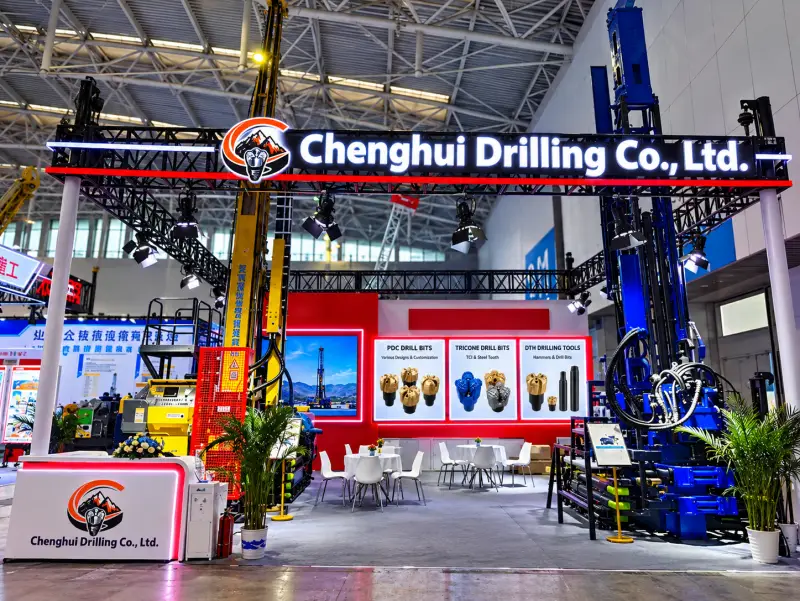
From September 10 to 12, 2026, the 28th CHINA MINING Conference and Exhibition was held at the Tianjin Meijiang Convention and Exhibition Center in Tianjin, China.
With the theme “Win-Win Cooperation, Green and Intelligent Mining,” the event brought together mining companies, geological exploration organizations, equipment manufacturers, technology providers and industry professionals from China and international markets.
For companies involved in drilling tools and geological exploration, CHINA MINING 2026 highlighted an important change in the market:
Customers are no longer simply looking for a drill bit. They are looking for a drilling solution that can reduce cost per meter, improve penetration efficiency and perform reliably in the actual formation.
That change is shaping the future development of PDC drill bits, tricone bits, diamond core drilling tools, DTH systems and customized drilling products.
A Larger and More Technology-Focused Mining Event
CHINA MINING has developed into one of the major international mining industry events held in China.
The 2026 exhibition reached approximately 65,000 square meters, with hundreds of companies participating across areas such as:
- Mining equipment
- Geological exploration
- Drilling technology
- Mining machinery
- Smart mining
- Mineral processing
- Mining services
- New energy resources
- Mine digitalization
- Equipment components and accessories
The event also placed significant attention on green mining, intelligent equipment, digital technologies and more efficient mineral exploration.
These trends may appear far removed from something as small as a drill bit, but in reality the drilling tool is directly connected to all of them.
A more efficient bit means fewer trips, less downtime, better use of rig power and potentially lower drilling cost.
Drilling Efficiency Is Becoming More Important Than Bit Price
One of the biggest changes in the drilling market is the way professional contractors evaluate drilling tools.
Years ago, purchasing decisions were often strongly influenced by the purchase price of the bit.
Today, experienced drilling contractors increasingly look at total drilling cost.
A cheaper drill bit is not always the least expensive solution.
For example, two bits may have very different purchase prices, but their real economics depend on:
- Penetration rate
- Total meters drilled
- Cutter wear
- Gauge wear
- Number of bit changes
- Rig downtime
- Fuel or electricity consumption
- Labor cost
- Flushing requirements
- Maintenance
- Hole quality
This leads to a much more useful measurement: Cost Per Meter.
A drill bit that costs more initially may actually produce a lower total drilling cost if it:
- Drills faster
- Lasts longer
- Requires fewer bit changes
- Maintains diameter better
- Reduces vibration
- Provides more stable drilling
For deep boreholes and mineral exploration projects, the cost of pulling the drill string simply to replace a worn bit can become significant.
This is why bit life and drilling stability matter almost as much as penetration rate.
Formation Matching Is Becoming the Core of Drill Bit Selection
There is no universal “best drill bit.”
There is only a drill bit that is better matched to a particular formation, machine and drilling objective.
Before selecting a drilling tool, several geological characteristics should be considered:
Rock Strength
Soft formations generally require a different cutting structure from hard formations.
Abrasiveness
Quartz-rich and highly abrasive formations may cause rapid cutter, gauge and body wear even when compressive strength is not extremely high.
Formation Integrity
A uniform formation behaves very differently from fractured or interbedded rock.
Impact and Vibration
Interrupted cutting can create impact loads that may damage PDC cutters or reduce drilling stability.
Drilling Depth
As the borehole becomes deeper, reliability and bit life become increasingly important because every unnecessary trip costs more time.
Understanding these conditions allows the cutting structure to be designed rather than simply selected by diameter.
PDC Drill Bits: Efficient Cutting for Suitable Formations
PDC drill bits use polycrystalline diamond compact cutters to shear the formation.
Instead of relying mainly on crushing rock, PDC cutters remove material through a continuous shearing action.
When properly matched to the formation, this cutting mechanism can provide:
- High penetration rates
- Smooth drilling
- Good wear resistance
- Relatively stable borehole diameter
- Fewer moving parts
- Long service life
PDC drill bits are available in many structures, including:
- Flat-top PDC bits
- Concave PDC bits
- Arc-profile PDC bits
- Spiral PDC bits
- Three-blade PDC bits
- Four-blade PDC bits
- Five-blade PDC bits
- PDC drag bits
- PDC core bits
- Customized PDC bits
However, simply increasing the number of cutters does not automatically create a better drill bit.
The design must balance:
cutting efficiency + cutter load + debris removal + stability + wear resistance
Blade geometry, cutter size, cutter exposure, cutter orientation, waterways and gauge protection all influence the final performance.
Why Customized PDC Designs Are Increasing
Mining and engineering contractors increasingly encounter drilling conditions where standard catalog products are not ideal.
For example, one customer may need higher penetration in relatively soft sedimentary rock, while another requires better cutter protection in fractured limestone, and another may need additional gauge protection for abrasive sandstone.
Even when all three customers use the same diameter, the ideal bit design may be completely different.
Customized PDC drill bits can therefore be adjusted through:
- Blade number
- Cutter quantity
- Cutter size
- Cutter distribution
- Bit profile
- Gauge length
- Gauge protection
- Waterway design
- Connection type
- Hardfacing
- Body structure
The objective is not simply to manufacture a different-looking drill bit.
The objective is to control how the bit interacts with the rock.
Tricone Drill Bits Still Have an Important Role
The continued development of PDC technology does not mean tricone bits are becoming obsolete.
Tricone drill bits operate using three rotating cones equipped with steel teeth or tungsten carbide inserts.
Their rock-breaking mechanism includes crushing, indentation and scraping.
This makes them particularly useful in many formations where impact resistance and adaptability are important.
TCI Tricone Drill Bits
TCI bits use tungsten carbide inserts and are widely used in medium, hard and abrasive formations.
Depending on the IADC structure and insert geometry, they may be selected for:
- Limestone
- Dolomite
- Sandstone
- Hard sedimentary formations
- Mining blast holes
- Water wells
- Exploration drilling
Steel Tooth Tricone Bits
Steel-tooth bits use machined teeth and are generally more suitable for softer formations where longer, more aggressive teeth can provide fast penetration.
They can work effectively in formations such as:
- Clay
- Soft shale
- Soft limestone
- Mudstone
- Relatively soft sedimentary rock
The correct choice between PDC and tricone should therefore be based on geology rather than market trends.
Diamond Core Drilling Remains Essential for Mineral Exploration
Mining exploration is not always about drilling a hole as quickly as possible.
Geologists often need intact core samples.
A core sample can provide valuable information about:
- Lithology
- Mineralization
- Rock structure
- Fractures
- Geological boundaries
- Ore characteristics
- Rock quality
For this reason, diamond core drilling remains one of the most important technologies in geological exploration.
Common systems include:
AQ · BQ · NQ · HQ · PQ · NTW · HTW
Products used within these systems may include:
- Impregnated diamond core bits
- Surface-set or electroplated diamond bits
- Reaming shells
- Core barrels
- Wireline drilling tools
- Drill rods
- Casing
- Other core drilling accessories
The matrix and diamond characteristics of an impregnated bit must be matched carefully to the formation.
Generally, formation hardness and abrasiveness strongly affect matrix selection and diamond exposure.
A poorly matched bit can glaze, wear prematurely or provide unsatisfactory penetration.
DTH Drilling for Hard and Competent Rock
Hard crystalline formations often require a completely different drilling principle.
DTH, or Down-the-Hole drilling, uses compressed air to operate a hammer directly behind the drill bit.
Because impact energy is generated close to the bottom of the hole, DTH drilling can maintain effective energy transfer even as drilling depth increases.
DTH systems are widely used in:
- Mining
- Quarrying
- Water well drilling
- Blast-hole drilling
- Construction drilling
- Hard-rock drilling
Typical DTH tools include:
- DTH hammers
- DTH drill bits
- Drill pipes
- Sub adapters
- Couplings
- Other drilling accessories
For competent hard rock such as granite and other crystalline formations, DTH drilling can offer a strong combination of penetration rate and borehole stability.
Used Drill Bits Provide Valuable Geological Information
One overlooked source of drilling information is the drill bit after it has been used.
A worn drill bit is almost like a record of what happened underground.
| Wear Condition | Possible Cause |
|---|---|
| Chipped PDC cutters | Impact, vibration or fractured formation |
| Heavy gauge wear | Highly abrasive rock |
| Uneven cutter wear | Uneven loading or unstable drilling |
| Body erosion | Abrasive cuttings or high fluid erosion |
| Bit balling | Poor cuttings removal or sticky formation |
| Broken teeth/inserts | Excessive impact or unsuitable operating parameters |
This is why photos of used drilling tools can be extremely useful when troubleshooting a drilling problem.
When requesting a customized bit, customers can provide:
- Used-bit photographs
- Rock samples
- Rock photographs
- Core samples
- Borehole information
- Rig specifications
- Previous drilling records
The more information available, the more accurately the bit can be matched to the application.
Smart Mining Begins With Better Drilling Data
The idea of intelligent mining is often associated with automation, sensors, artificial intelligence and autonomous equipment.
But intelligent mining also depends on better decisions at the drilling stage.
Drilling data can reveal useful information about:
- Formation changes
- Penetration rate
- Torque
- Rotation speed
- Weight on bit
- Air or fluid pressure
- Tool wear
- Energy consumption
When this information is combined with geological data, drilling contractors can gradually improve bit selection and operating parameters.
The future is therefore unlikely to be only about stronger drill bits.
It will increasingly involve the combination of:
better drilling tools + better geological understanding + better operating data
Green Mining Also Requires Efficient Drilling
The theme of CHINA MINING 2026 placed clear emphasis on green and intelligent mining.
For drilling operations, environmental improvement does not necessarily begin with completely new equipment.
Efficiency itself can reduce resource use.
A drill bit that:
- Drills more meters before replacement
- Maintains stable penetration
- Requires fewer trips
- Reduces unnecessary energy use
- Produces predictable performance
can help improve the efficiency of the entire drilling operation.
Longer tool life may also mean fewer replacement tools need to be manufactured, transported and handled over the course of a project.
For this reason, tool life and cost per meter are becoming increasingly important engineering indicators.
What Information Should Be Provided Before Ordering a Drill Bit?
One of the easiest ways to improve drilling results is to provide sufficient information before purchasing the tool.
Instead of simply asking:
“How much is a 152 mm drill bit?”
a professional inquiry should ideally contain:
- Required bit diameter
- Target drilling depth
- Rock type
- Approximate rock hardness
- Formation abrasiveness
- Whether the formation is solid or fractured
- Rig model
- Rotary speed
- Torque
- Weight on bit
- Air or mud flushing system
- Thread or connection
- Previous bit performance
Photographs of the rock and used drill bits are also extremely useful.
This information helps the manufacturer determine whether a PDC, tricone, diamond or DTH solution is more suitable.
China’s Drilling Tool Industry Is Moving Beyond Basic Manufacturing
International customers once selected Chinese drilling products primarily because of manufacturing cost.
That is changing.
Mining and drilling contractors increasingly expect manufacturers to provide:
- Product customization
- Formation analysis
- Faster technical communication
- Stable quality control
- Consistent cutter selection
- Reliable connections
- Wear protection
- Application recommendations
- OEM manufacturing
- After-sales technical support
For drilling tool manufacturers, this means the future competitive advantage will not come from price alone.
The ability to understand the application is becoming equally important.
Chenghui’s Approach to Mining and Exploration Drilling
Chenghui develops and supplies drilling tools for mineral exploration, mining, water wells and engineering drilling applications.
Our product range includes:
- PDC drill bits
- PDC core bits
- Diamond core drilling tools
- TCI tricone bits
- Steel-tooth tricone bits
- Roller cutters
- DTH hammers
- DTH drill bits
- Drill rods and drilling accessories
- Customized drilling tools
For customized drilling projects, we encourage customers to provide as much formation and equipment information as possible.
Rather than recommending a product only by diameter, we prefer to understand:
the rock, the rig and the drilling objective.
That information makes it possible to select or design a more appropriate drilling tool.
Looking Beyond CHINA MINING 2026
CHINA MINING 2026 showed that mining is moving toward greater efficiency, intelligence and sustainability.
For drilling-tool manufacturers, the message is equally clear.
Future drilling products will need to provide:
- More predictable performance
- Better wear resistance
- Longer useful life
- Improved formation adaptability
- Stable borehole quality
- Lower overall cost per meter
PDC, tricone, diamond and DTH technologies will all continue to have their place.
The real challenge is knowing which technology should be used in which formation.
That is where technical experience, application data and customized manufacturing become increasingly valuable.
The best drilling tool is not necessarily the most expensive one, the newest one or the one with the largest number of cutters.
It is the tool that matches the rock, the drilling equipment and the job.
Frequently Asked Questions
When and where was CHINA MINING 2026 held?
The 28th CHINA MINING Conference and Exhibition was held from September 10 to 12, 2026, at the Tianjin Meijiang Convention and Exhibition Center in Tianjin, China.
What was the theme of CHINA MINING 2026?
The theme was “Win-Win Cooperation, Green and Intelligent Mining.”
Is a PDC drill bit always better than a tricone bit?
No. PDC bits can provide excellent penetration and tool life in suitable formations, while tricone bits may perform better in certain fractured, variable or impact-intensive formations. Selection should be based on geology and drilling conditions.
Which drill bits are commonly used for mineral exploration?
Depending on the drilling objective and formation, mineral exploration can use PDC core bits, impregnated diamond core bits, tricone bits and other specialized drilling tools.
What information is required for a customized drill bit?
Important information includes bit diameter, drilling depth, rock type, rock strength, abrasiveness, fracture condition, rig specifications, RPM, torque, flushing method and connection type. Rock photographs and photographs of previously used bits can also be extremely valuable.
Why is cost per meter more important than drill bit price?
Because drill bit price represents only one part of the total drilling cost. Tool life, penetration rate, bit-change frequency, rig downtime, labor and energy consumption can have a much greater effect on the final project cost.