
Mastering PDC Cutter Size Selection: A Technical Guide to Maximize Drilling Efficiency
⏱️ 8 min read
⚙️ #PDCCutter #DrillingEfficiency #ROP
Selecting the right Polycrystalline Diamond Compact (PDC) cutter for your drilling operation is one of the most critical technical decisions you’ll make. It directly influences your rate of penetration (ROP), bit durability, and ultimately, your project’s profitability. However, with codes like 1308, 1616, and 1916, the selection process can seem overly complex. Choosing incorrectly often leads to slow progress, premature tool failure, and blown budgets.
At Chenghui Drilling Tools, we believe that understanding cutter dimensions is the key to unlocking superior drilling performance. This guide provides a practical, data-driven approach to matching PDC cutter sizes to specific rock formations, helping you make informed decisions that optimize both speed and operational cost.
Decoding PDC Cutter Dimensions
A PDC cutter is a superhard composite material, consisting of a polycrystalline diamond layer sintered onto a tungsten carbide substrate. This combination provides the hardness needed for cutting and the toughness required for impact resistance.
The industry standard for identifying cutter size is a four-digit code:
- First two digits: Cutter diameter (mm)
- Last two digits: Cutter total thickness (mm)
For example, a 1308 cutter has a diameter of 13mm and a thickness of 8mm. This simple coding system allows drillers to quickly identify the cutter’s primary physical characteristics and predict its behavior in different geological conditions.
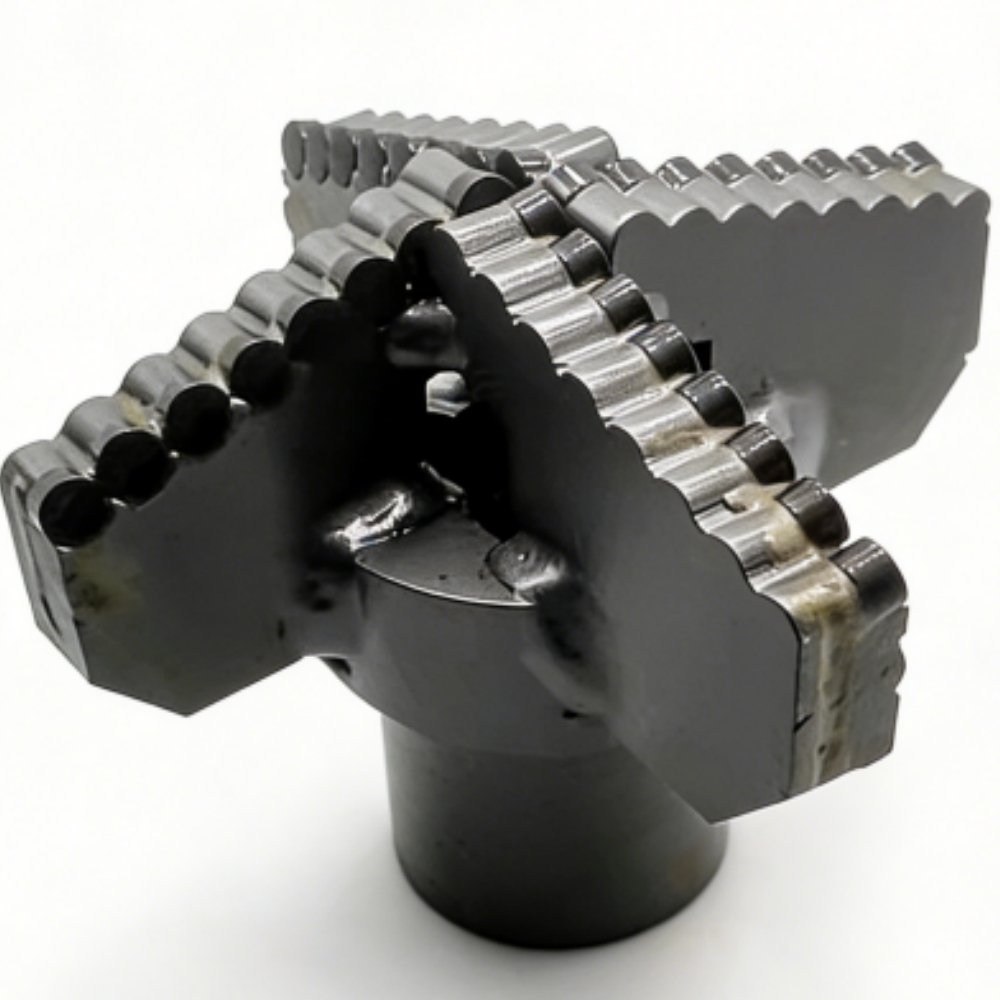
Four-wing PDC scraper drill bit – engineered for efficient drilling in soft to medium formations.
Click image to explore our full PDC drill bit range.
| Cutter Code | Diameter (mm) | Thickness (mm) |
|---|---|---|
| 1308 | 13 | 8 |
| 1313 | 13 | 13 |
| 1613 | 16 | 13 |
| 1616 | 16 | 16 |
| 1913 | 19 | 13 |
| 1916 | 19 | 16 |
The Core Principle: Matching Cutter Size to Formation Hardness
The primary factor dictating cutter size selection is the hardness and abrasiveness of the target formation. There is no single “best” cutter size; the optimal choice depends entirely on downhole conditions.
⛰️
Hard Formations
Granite, Basalt, Hard Sandstone
Recommended: 13mm cutters (1308, 1313)
Smaller diameter cutters concentrate WOB into higher point loading for effective penetration. They also experience lower impact forces, reducing chipping risk and extending bit life.
🪨
Medium Formations
Limestone, Shale, Medium Sandstone
Recommended: 16mm cutters (1613, 1616)
Balanced approach offering good compromise between durability and cutting aggression. Ideal for mixed or moderately hard formations where conditions vary.
🏝️
Soft Formations
Clay, Chalk, Unconsolidated Sands
Recommended: 19mm cutters (1913, 1916)
Larger exposed surface allows “bigger bite” per rotation, resulting in significantly higher ROP. Maximizing speed is the primary objective in these conditions.
The Trade-Off: Drilling Speed vs. Bit Life
Understanding the inherent trade-off between ROP and bit durability is essential for cost-effective drilling.
⚡
Larger Cutters (16mm, 19mm)
Higher aggression and faster ROP in soft formations. However, if used in hard rock, they become prone to impact damage, leading to premature bit failure.
🛡️
Smaller Cutters (13mm)
More durable and resistant to wear in hard, abrasive environments. Maximize bit life and reduce trips, but drill unacceptably slow in soft formations.
The goal is to strike the right balance for your specific application. Using an overly aggressive bit in hard rock may seem fast initially, but the cost of pulling out a damaged bit and tripping back in often outweighs any early gains.
Optimizing Total Drilling Cost
The initial purchase price of a drill bit is only a fraction of the total drilling cost. The true measure of economic efficiency is cost per foot (or meter). This metric accounts for bit cost, rig operating rate, and trip time.
A properly selected PDC cutter directly lowers cost per foot by:
- Maximizing ROP: Faster drilling reduces total hours on the rig.
- Extending Bit Life: A durable bit that matches the formation stays in the hole longer, minimizing costly round trips.
“Using a bit with large, aggressive cutters in a hard rock application might offer a lower upfront cost, but the resulting high-frequency trips for bit replacement will quickly erase any savings. Conversely, a bit from Chenghui Drilling Tools with the correct, durable smaller cutters may have a higher initial price but will deliver a far lower cost per foot by staying in the hole and making steady progress.”
Quick Selection Guide: Matching Cutter Size to Ground Conditions
| Cutter Dimensions | Suitable Ground Layer |
|---|---|
| 13mm × 8mm (1308), 13mm × 13mm (1313) | Hard Formations (High durability, high point loading) |
| 16mm × 13mm (1613), 16mm × 16mm (1616) | Medium Formations (Balanced performance and speed) |
| 19mm × 13mm (1913), 19mm × 16mm (1916) | Soft Formations (Maximum rate of penetration) |
Conclusion
Understanding PDC cutter dimensions is not merely a technical detail—it is a fundamental factor that determines drilling success. Selecting the right size for your specific rock formation directly improves ROP, extends bit life, and optimizes your total project costs.
At Chenghui Drilling Tools, we specialize in helping clients navigate these critical choices. By combining accurate technical specifications with real-world application expertise, we ensure that every bit we provide is configured for maximum performance and efficiency in your specific downhole environment.
Ready to optimize your drilling operation?
Share your formation details with our team, and we will recommend the optimal PDC bit configuration to help you drill faster, reduce downtime, and lower your cost per foot.
🔗 Related Resources
Need Expert PDC Cutter Selection?
Our engineering team can analyze your formation data and recommend the optimal PDC cutter size and configuration for your specific drilling environment.
Keywords: PDC cutter size, PDC cutter selection, 1308 cutter, 1616 cutter, 1916 cutter, drilling efficiency, ROP optimization, cost per foot, hard rock drilling, soft formation drilling, Chenghui drilling tools.