
⏱️ 8 min read
🔧 #Hardfacing #PDCbits #CostPerMeter
In abrasive and hard rock formations, drilling efficiency depends not only on penetration rate but also on bit longevity. However, many contractors focus only on the initial purchase price. In contrast, experienced drilling engineers understand that the real metric is cost per meter drilled.
Frequent bit trips, gauge wear, cutter loss, and body erosion can dramatically increase operational costs. This guide explains:
- Why standard PDC bits fail in abrasive formations
- How tungsten carbide hardfacing changes performance
- What features truly matter when selecting a PDC rock drill bit
- How to reduce downtime and improve drilling stability
This article is essential for professionals in mining, geothermal, infrastructure, or geological drilling.
1. Why Standard PDC Bits Fail in Abrasive Rock
Abrasive formations contain hard mineral particles that act like sandpaper. The most common failure points are:
Gauge Wear
When the outer diameter wears down, the borehole becomes undersized. As a result, reaming may be required, and directional control becomes unstable.
Blade Body Erosion
High‑velocity drilling fluid carrying cuttings continuously impacts the blade root and junk slots. This action gradually removes steel material.
Cutter Damage
Hard‑soft transitions cause impact loading, which may lead to cutter chipping or premature dulling.
The result is reduced drilling speed, more frequent bit trips, and increased non‑productive time (NPT).
2. What Makes Tungsten Carbide Hardfacing Different?
Not all PDC rock drill bits are built for high abrasion. However, a tungsten carbide hardfacing PDC drill bit adds a reinforced protective layer to high‑wear areas such as:
Blade edges
Junk slots
Hydraulic channels
Tungsten carbide is applied using plasma arc welding (PAW). This process creates a metallurgical bond with the bit body, leading to:
- ✔ Superior wear resistance
- ✔ Strong erosion protection
- ✔ Longer structural integrity
- ✔ Improved gauge retention
In short, the bit body survives as long as the cutters do.
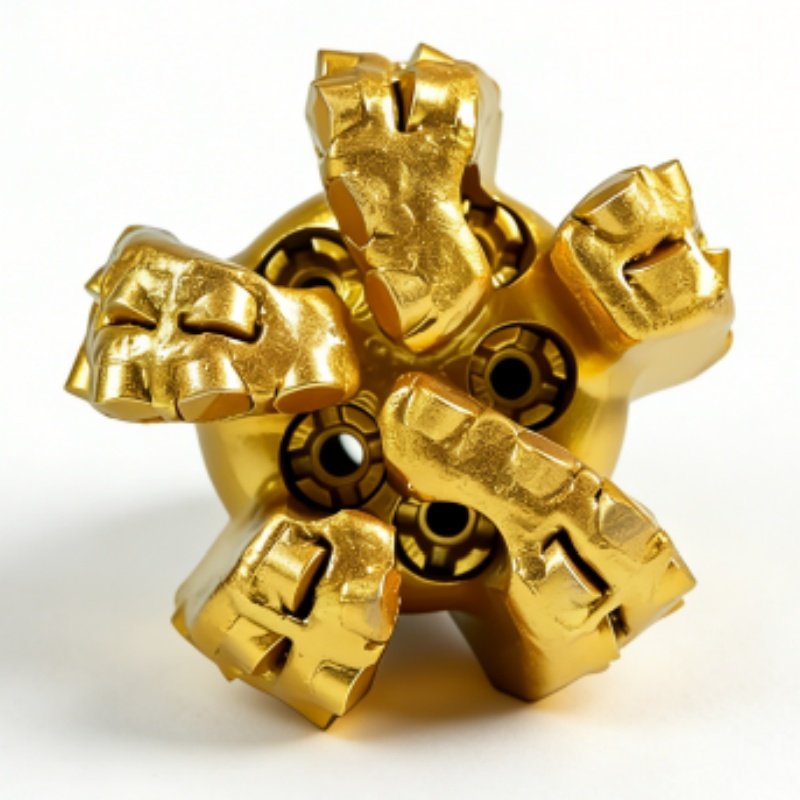
Tungsten carbide hardfacing PDC drill bit – reinforced for abrasive formations
3. Key Factors to Consider When Buying a PDC Rock Drill Bit
Instead of asking “What is the price?”, ask these:
- ✅ Is the bit designed for my formation hardness? Bits designed for soft-to-medium formations are not suitable for high abrasive rock.
- ✅ Does it have reinforced gauge protection? Gauge protection is critical for directional drilling and hole quality.
- ✅ What hardfacing method is used? Plasma arc welding provides stronger adhesion than simple spray coatings.
- ✅ What is the cutter quality? Thermally stable PDC cutters perform better under high temperature and impact stress.
- ✅ Can the manufacturer customize blade count and layout? Formation‑specific design improves efficiency and reduces vibration.
4. How Hardfacing Improves Cost per Meter Drilled
Let’s compare the performance:
| Standard Bit | Hardfacing PDC Bit |
|---|---|
| Short bit life | Extended drilling time |
| Frequent replacement | Fewer trips |
| Gauge shrinkage | Stable hole diameter |
| Body erosion | Reinforced protection |
Although a hardfacing bit may have a higher initial cost, it often significantly reduces total drilling cost. This is achieved by:
- Increasing footage per run
- Reducing downtime
- Lowering operational interruption risk
That’s why experienced operators focus on lifecycle performance rather than just the purchase price.
5. Ideal Applications for Hardfacing PDC Drill Bits
Mining Exploration
Hard rock core drilling and blast hole drilling in abrasive mineral formations.
Geothermal Wells
High temperature and volcanic formations require both thermal stability and abrasion resistance.
Infrastructure
Pile drilling in mixed formations with rock layers.
Geological Survey
Maintaining borehole quality in deep, variable formations.
6. When Should You Choose a Custom PDC Bit?
Standard sizes work for common conditions. However, you should consider custom design if:
- Formation includes extreme abrasive quartz content
- Directional control is critical
- Drilling depth is significant
- Vibration or bit whirl has been an issue
- Previous bit performance was unsatisfactory
Custom blade configuration and cutter layout can significantly improve drilling stability and penetration rate.
7. Final Thoughts: Choose Performance, Not Just Price
Ultimately, in abrasive formations, the drill bit is not just a consumable tool—it is the core productivity driver. Choosing a reinforced tungsten carbide hardfacing PDC rock drill bit can:
- Extend bit life
- Maintain gauge accuracy
- Reduce downtime
- Improve drilling stability
- Lower cost per meter
When evaluating suppliers, prioritize:
- Manufacturing quality control
- Hardfacing process
- Custom engineering support
- Production lead time reliability
A well-designed bit doesn’t just drill faster — it drills smarter.
Optimize Your Drilling Performance
If you are currently facing premature bit wear or unstable drilling performance, consider evaluating a hardfacing PDC solution. These bits are designed specifically for abrasive formations. By providing your formation data and drilling parameters, our engineers can recommend a more cost-effective and reliable bit design.
Keywords: PDC rock drill bit, tungsten carbide hardfacing, abrasive formations, cost per meter drilled, gauge wear protection, plasma arc welding, mining drilling bits, geothermal drilling tools, custom PDC bits, Chenghui drilling tools, bit selection guide, drilling cost reduction.